

Composite regenerative matrix for barrier-free bone regeneration: Full-mouth rehabilitation with long-term stability

Abstract

We described a novel composite regenerative matrix (CRM) designed to improve the handling and stability of sticky bone and advanced platelet-rich fibrin (PRF). The CRM combined autologous fibrinogen glue, allograft, and type I collagen and was processed through repeated compression cycles to enhance graft cohesion. A patient with generalized advanced periodontitis presented with severe vertical and horizontal alveolar bone loss, including a rare no-wall defect in the anterior mandible was reported in this study. Following periodontal therapy and extraction of unrestorable teeth, the CRM was used for socket regeneration and ridge augmentation without a membrane. Delayed implant placement and full-arch rehabilitation were subsequently performed. Clinical and radiographic outcomes demonstrated substantial vertical bone gain, stable peri-implant tissues, and favorable esthetics. The 6 -year post-operative cone-beam computed tomography confirmed cortical bone formation. Thus, the CRM may provide a clinically feasible and predictable membrane-free option for complex alveolar defects for which conventional guided bone regeneration is limited.

Keywords

Platelet-rich fibrin
Alveolar ridge augmentation
Bone regeneration

Introduction

Guided bone regeneration (GBR) has been widely applied for alveolar ridge augmentation using barrier membranes to stabilize graft materials and exclude soft tissue ingrowth. However, membrane-related complications such as exposure, infection, and impaired revascularization remain major clinical challenges, particularly regarding vertical ridge augmentation and advanced periodontal defects.123 These limitations have stimulated growing interest in membrane-free regenerative strategies.
Vertical ridge augmentation, especially for defects with limited or absent bony walls, continues to represent one of the most technically demanding procedures in implant dentistry, with increased risks of complications and unpredictable outcomes.3,4
Composite grafting approaches combining autologous blood-derived matrices with particulate bone substitutes have been introduced to improve graft cohesion and handling characteristics during ridge augmentation procedures.567 Building on this concept, the composite regenerative matrix (CRM) integrates autologous fibrinogen glue (AFG), freeze-dried bone allograft (FDBA), and collagen into a cohesive scaffold through repeated compression and reapplication cycles. This preparation enhances structural stability and facilitates controlled placement without barrier membranes.
The present report described the application of CRM in a challenging full-mouth rehabilitation case involving severe vertical bone loss and a rare no-wall defect, with long-term clinical and radiographic follow-up.

Materials and methods

Materials used

Freeze-dried bone allograft (FDBA)

A commercially available allograft material OraGraft® (LifeNet Health, Virginia Beach, VA, USA) was used, with particle sizes ranging from 250 to 1000 μm. FDBA served as the primary osteoconductive scaffold.

Autologous fibrinogen glue (AFG)

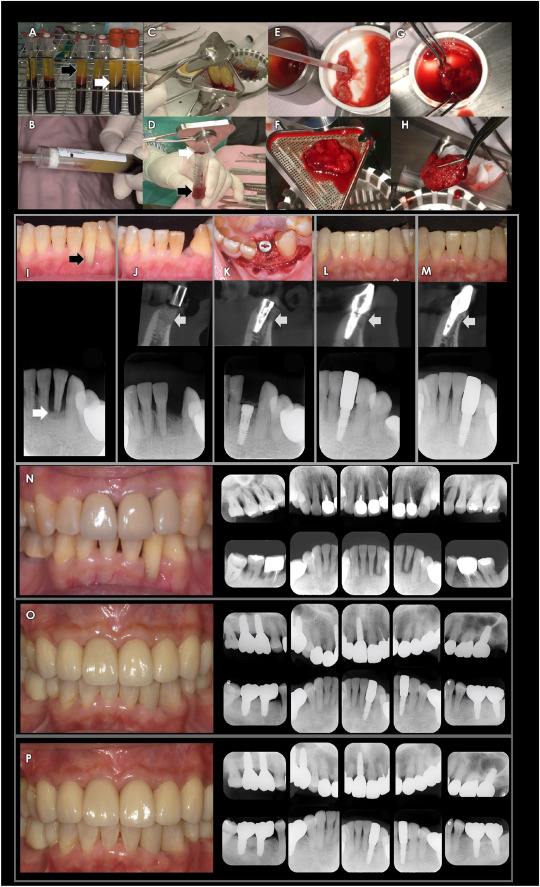
AFG was prepared from each patient’s blood by using a concentrated growth factor (CGF) centrifugation protocol with a Medifuge® device (Silfradent, Santa Sofia, Italy). The preparation yielded a fibrinogen-rich solution containing platelets and multiple growth factors (Fig. 1A, white arrow).
 

Figure 1. Preparation of the composite regenerative matrix (CRM) and treatment results. (A) Autologous blood was centrifuged using a concentrated growth factor (CGF) system with growth factor–rich autologous fibrinogen glue (AFG) in plastic tubes (white arrow) and coagulated CGF plugs in glass-coated tubes (black arrow). (B) Growth factor–rich AFG was aspirated from the plastic tube. (C) Coagulated CGF plugs obtained from glass-coated tubes were placed in a self-developed pressing device (D) upon closure of the self-developed device, and liquid autologous thrombin was expressed through the outlet (white arrow) and collected in a plastic syringe (black arrow). (E) Freeze-dried bone allograft (FDBA) particles were mixed with AFG in a sterile manipulation dish, and coagulation was initiated by adding autologous thrombin. (F) The composite matrix was subjected to controlled condensation using a self-developed condenser. (G) The condensed matrix was gently loosened in areas of weak integration supplemented with additional AFG and thrombin and allowed to recoagulate. (H) This compression and reapplication process was repeated several times to obtain a cohesive CRM mass suitable for defect filling. (I) Preoperative clinical photograph and radiograph of the mandibular left lateral incisor (tooth 32) region before extraction. (J) Four months after extraction and CRM-assisted socket regeneration, clinical findings and cone-beam computed tomography demonstrated adequate bone regeneration (white arrow). (K) Delayed implant placement with a gingival former was subsequently performed, and additional CRM (white arrow) was applied to support the peri-implant soft tissue contours. (L) The final prosthesis of tooth 32 was delivered in 2018. (M) More than six years of follow-up demonstrated stable peri-implant bone with well-modeled cortical bone located above the buccal implant platform (white arrow). (N) Full-mouth rehabilitation and long-term follow-up. Pretreatment clinical photographs and full-mouth periapical radiographs. (O) As part of a comprehensive treatment plan, similar regenerative procedures were performed at other sites within the same patient. After the completion of full-mouth rehabilitation, the definitive prostheses and radiographic outcomes were documented after three years in 2021. (P) At the four-year follow-up of full-mouth rehabilitation in 2025, clinical examination and full-mouth periapical radiographs confirmed stable hard and soft tissue conditions following reconstruction and regeneration.

Autologous thrombin

Thrombin was isolated from autologous blood clots formed in silica-coated tubes (Fig. 1A, black arrow). This enzymatic agent was used to catalyze fibrinogen polymerization during matrix formation (Fig. 1B–D).

CRM preparation protocol

Initial mixing

In a sterile ceramic container, FDBA particles were homogeneously mixed with AFG to ensure that bioactive components are evenly distributed (Fig. 1E).

Thrombin-induced coagulation

A thrombin solution was added to the FDBA–AFG mixture to initiate fibrin polymerization, resulting in the formation of a semicoagulated matrix enriched with growth factors. This facilitated the aggregation of FDBA particles within the fibrin network (Fig. 1D and E).

Primary compression

The coagulated mixture was compressed using a specialized compression device to densify the fibrin network between bone particles, improving the mechanical integrity of the matrix (Fig. 1F).

Loosening and reapplication

The compressed block was carefully loosened using a blunt instrument to disrupt areas with weak fibrin integration. Additional AFG and thrombin were reapplied to these areas to reinforce fibrin polymerization and fill interstitial voids (Fig. 1G).

Secondary coagulation and compression

Following reapplication, the matrix was subjected to a second round of controlled compression. This cycle was repeated 2–5 times to gradually increase the fibrin density, growth factor concentration, and overall scaffold cohesion. Repeated compression cycles were applied to densify the fibrin network, a process shown to induce nonlinear viscoelastic hardening through structural rearrangements of fibrin fibers (Fig. 1H).
This modified protocol allows intraoperative tailoring of the CRM density and growth factor distribution, depending on the defect morphology and regenerative goals.

Ethical consideration

This report was approved by the Institutional Review Board, National Cheng Kung University Hospital, Tainan, Taiwan.

Results

A 49-year-old woman presented with functional impairment and esthetic concerns related to generalized periodontitis came for treatment of her periodontal disease. The patient was systemically healthy and a nonsmoker. Clinical and radiographic examinations revealed generalized moderate-to-severe periodontal bone loss, tooth mobility, and multiple unrestorable teeth.
A particularly challenging finding was a severe vertical alveolar defect with complete loss of surrounding bony walls (“no-wall defect”) in the mandibular anterior region (site 32). Several other regions also exhibited advanced horizontal and vertical bone deficiencies (Fig. 1I).
Comprehensive periodontal therapy was initiated, including full-mouth scaling and root planing, occlusal adjustment, and oral hygiene instruction. Teeth with a poor prognosis were extracted in a staged manner. Immediately following extraction, socket regeneration was performed using the CRM without barrier membranes. The matrix was placed to fill the defect and support the surrounding soft tissues. At selected sites, an AFG-infused collagen sheet Terudermis® (Terumo Corporation, Tokyo, Japan) was applied to the soft tissue-facing surface to stabilize the wound.
After adequate healing (Fig. 1J), delayed implant placement was performed at regenerated sites, including the mandibular anterior region. Gingival formers were used to tent the peri-implant soft tissues, and additional CRM was applied where indicated to support vertical tissue contours (Fig. 1K). Posterior regions requiring soft tissue enhancement were managed with free palatal mucosal grafts. As part of the comprehensive treatment plan, similar regenerative procedures were performed at other sites in the same arch.
Postoperative healing was uneventful, with no complications, such as infection, graft exposure, or wound dehiscence. In the mandibular anterior region, substantial vertical bone regeneration was observed, successfully resolving the no-wall defect (Fig. 1L). Cone-beam computed tomography scan obtained six years after regeneration confirmed the presence of cortical bone and mature trabecular architecture above the implant platform (Fig. 1M). Other treated sites also demonstrated stable bone levels and healthy peri-implant soft tissues.
More than 4 years after the completion of full-arch prosthetic rehabilitation, clinical examination and radiographic evaluation revealed harmonized gingival contours, stable peri-implant bone levels, and satisfactory esthetic integration. The patient reported no functional discomfort and expressed high levels of satisfaction with both function and appearance (Fig. 1N–P).

Discussion

Vertical ridge augmentation and no-wall defects remain among the most challenging scenarios in implant dentistry, particularly because of limited bony containment and increased risks of postoperative complications.8,9 Conventional guided bone regeneration (GBR) techniques rely on barrier membranes to stabilize graft materials and exclude soft tissue ingrowth; however, membrane exposure, infection, and compromised healing have frequently been reported, especially regarding extensive or anatomically unfavorable defects.123
A key innovation of the CRM protocol is the use of repetitive compression–reapplication cycles during matrix preparation. This process densifies the fibrin network, concentrates growth factors, and establishes a stiffness gradient that guides MSC migration via durotaxis. In addition, the repeated compression‒ condensation process effectively homogenizes the interparticle spacing and distribution of graft particles within the matrix, making the handling process more controllable and efficient (Fig. 1H). The structural reorganization of fibrin fibers also increases their local concentration, thereby enriching integrin-binding arginylglycylaspartic acid (RGD) ligands within the matrix. This creates a favorable microenvironment for haptotactic migration, further supporting the directional movement of progenitor cells. The structured microarchitecture additionally sequesters chemotactic factors such as stromal cell-derived factor (SDF-1α) and platelet-derived growth factor subunit B (PDGF-BB) for sustained release, enhancing progenitor cell recruitment and angiogenesis. Notably, tuning the matrix stiffness to 10 kPa or higher has been shown to promote macrophage polarization toward the reparative M2 phenotype, thereby attenuating inflammatory responses and fostering an immunomodulatory niche.
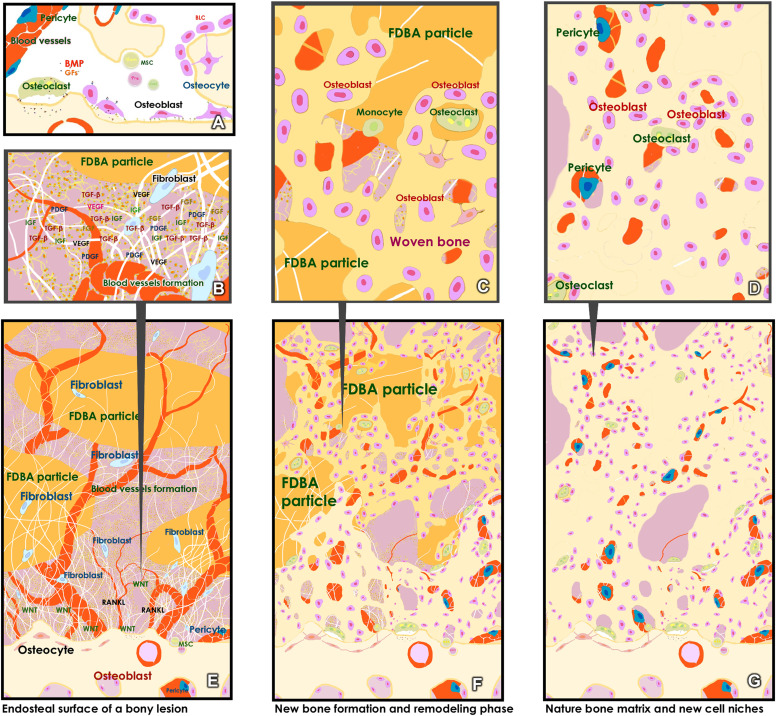
This phenomenon may be attributed to a coordinated cellular response, wherein osteoclast-mediated resorption of the graft matrix is coupled with osteoblast-driven bone deposition. Such a process reflects a physiological remodeling mechanism in which the CRM is gradually resorbed and replaced by mature, load-bearing bone through cellular coupling of osteoclast activity and osteoblast activity. The CRM may therefore not only facilitate initial bone augmentation but also enable sustained, biologically regulated remodeling through cellular coupling mechanisms (Fig. 2).


Figure 2. Conceptual schematic illustration of proposed biological events during the composite regenerative matrix (CRM)-assisted bone regeneration. (A) In a physiological bony environment, bone regeneration and remodeling are regulated by coordinated interactions among bone cells (osteoblasts, osteoclasts, osteocytes), their progenitors, the extracellular matrix (ECM), and local signaling cues. (B) Following the placement of a CRM, a fibrin-based scaffold incorporating freeze-dried bone allograft (FDBA) particles is proposed to provide a provisional matrix enriched with autologous blood-derived components. This matrix may support early vascular ingrowth and cellular migration within the defect space. (C) As regeneration progresses, osteoblast-mediated bone formation occurs in close association with the scaffold, resulting in the deposition of woven bone around residual graft particles. (D) Concurrently, osteoclasts derived from recruited mononuclear cells participate in bone remodeling by resorbing immature bone and graft material, contributing to matrix turnover and structural reorganization. (E and F) Through the coordinated bone formation and remodeling processes originating from both the endosteal and periosteal surfaces, the provisional matrix is gradually replaced by the newly formed bone with increasing mineral density and structural maturity. (G) Gradually, the continued remodeling results in a bone architecture resembling that of native alveolar bone with established cellular niches and vascular networks. This schematic represents a proposed biological sequence based on the current understanding of bone healing and is intended for illustrative purposes only.

In the present case, the CRM provided sufficient graft cohesion and spatial stability to facilitate predictable bone regeneration in the absence of barrier membranes. The absence of membrane-related complications and the long-term stability observed in this case suggest that mechanical containment by membranes may not always be indispensable when adequate graft integrity and biological integration can be achieved.
Compared with autogenous bone grafting, the use of CRM circumvents donor site morbidity and volume limitations while providing a clinically manageable scaffold.10 The fibrin-based matrix used in CRM preparation provides structural cohesion and biological compatibility consistent with the known properties of fibrin networks, which support cellular attachment and early wound stabilization.7 While the use of combinations of fibrin matrices and particulate bone grafts—such as CGF-enriched or platelet-rich fibrin–based “sticky bone” techniques—have previously been described, most studies have focused on short-term outcomes or limited defect morphologies.567
The present case extends these observations by demonstrating the successful application of a fibrin-based composite matrix in full-mouth rehabilitation involving severe vertical bone loss and a rare no-wall defect, with long-term clinical and radiographic follow-up exceeding six years. Nevertheless, this report is inherently limited by its single-case design and the absence of quantitative histomorphometric or comparative data. Future prospective studies and controlled clinical trials are needed to evaluate the reproducibility of this technique and to compare its outcomes with those of established GBR protocols.
In summary, CRM represents a minimally invasive and biologically integrative alternative to conventional GBR and autologous bone grafting, particularly for complex alveolar defects where membrane-related complications or donor site limitations are of concern. Future investigations focusing on quantitative assessment and broader clinical validation are warranted to further define its therapeutic potential.
This report demonstrates that a CRM composed of autologous fibrinogen glue and a freeze-dried bone allograft can support predictable, membrane-free bone regeneration in complex alveolar defects. This technique enables the successful management of severe vertical and no-wall defects during full-mouth rehabilitation, with stable functional and esthetic outcomes maintained over long-term follow-up. CRM may represent a clinically viable alternative to conventional GBR in selected challenging cases.

Declaration of competing interest

The authors have no conflicts of interest relevant to this article.

Acknowledgments

The authors received no financial support for the research, authorship, or publication of this article.